

The Hunger
Tony Scott, 1983

Some films are remembered for their stories. Others are remembered for how they make you feel. The Hunger belongs firmly in the second category. It is less concerned with conventional narrative than with mood, desire and decay, creating a hypnotic experience that lingers long after the plot has faded.
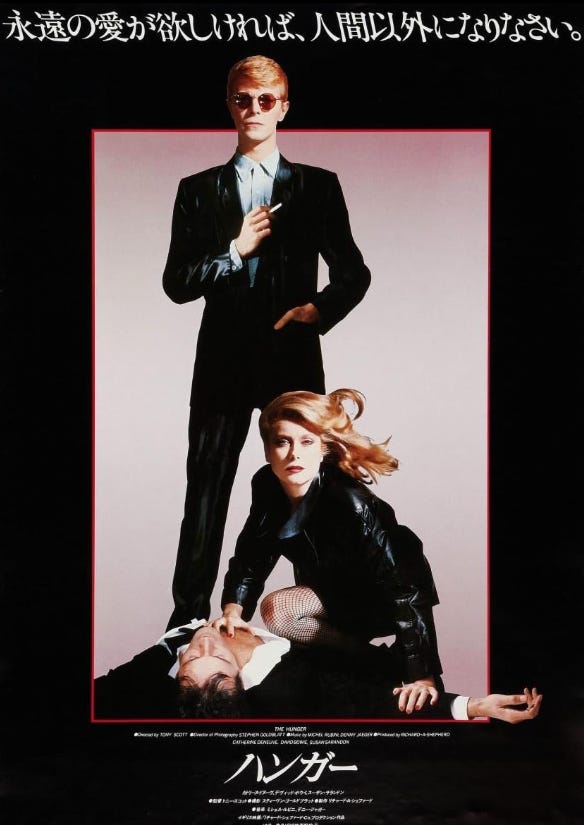
Credit: https://www.imdb.com/title/tt0085701/?ref_=nv_sr_srsg_7_tt_8_nm_0_in_0_q_the%20hunger
Directed by Tony Scott in his feature debut, The Hunger arrived years before the glossy visual style that would define much of Scott’s later career. Here, however, the style isn’t empty spectacle. Every shaft of light, every plume of smoke and every carefully composed frame contributes to a world where beauty and death exist side by side.
The film follows the centuries-old vampire Miriam Blaylock and her lover John, whose apparent immortality suddenly begins to unravel. As John rapidly ages, Miriam turns her attention to a scientist researching ageing, setting in motion a story that blends gothic horror, eroticism and existential tragedy.
That premise may sound like conventional vampire territory, but Scott has little interest in folklore. His vampires are elegant predators moving through museums, luxury apartments and concert halls rather than gothic castles. Their curse isn’t bloodlust so much as the unbearable loneliness of eternity.
Casting is everything.
Catherine Deneuve is mesmerising as Miriam, combining elegance with emotional detachment. She rarely raises her voice or makes grand gestures, yet dominates every scene. Miriam doesn’t need to threaten anyone. She simply exists with absolute certainty.
Opposite her, David Bowie delivers one of the most unexpectedly moving performances of his acting career. Bowie was no stranger to playing enigmatic figures, but John is something different. His transformation from youthful confidence to terrified physical collapse happens with astonishing speed, and Bowie makes every stage believable. Watching his body betray him while his mind remains intact becomes genuinely distressing.
The ageing make-up effects remain remarkably convincing, not because they are technically flawless by today’s standards, but because Bowie fully commits to the emotional reality beneath them. Vanity, panic, confusion and despair all surface without ever becoming melodramatic.
Then there’s Susan Sarandon, whose arrival shifts the film into something more emotionally complex. Her grounded performance provides an effective counterpoint to the almost mythic qualities of Bowie and Deneuve, making the increasingly surreal narrative feel emotionally anchored.
Behind the camera, Tony Scott was still developing the visual language that would later define films like Top Gun and True Romance. Working with cinematographer Stephen Goldblatt, he fills every frame with diffused light, smoke, mirrors and rich shadows. The influence of fashion photography is unmistakable, yet it never feels superficial. The immaculate surfaces reinforce the film’s central idea that beauty itself can become a prison.
The opening sequence alone has become iconic. Bowie and Deneuve hunt in a nightclub while Bauhaus perform Bela Lugosi’s Dead live on stage. It’s one of the great introductions in horror cinema, immediately announcing that this won’t be a traditional vampire film. Music, image and editing merge into something closer to a dream than conventional storytelling.
That visual ambition extended to the production itself. Scott reportedly storyboarded extensively, approaching scenes with the precision of a commercial director but applying that discipline to atmosphere rather than salesmanship. Every composition feels considered, almost painterly.
Critics were divided on release, many arguing that style overwhelmed substance. Time has been kinder. The film has become a cult classic precisely because of its refusal to explain everything. Modern audiences have embraced its ambiguity, its sensuality and its willingness to privilege emotion over exposition.
Perhaps its greatest strength is that beneath all the elegance lies a surprisingly melancholy meditation on ageing. Vampirism becomes less a fantasy than a metaphor for the desperate human desire to preserve youth at any cost. John’s fate is terrifying not because he dies, but because he experiences every fear associated with growing old in a matter of days.
Nearly forty years on, The Hunger still feels unlike almost anything else. Part gothic romance, part arthouse horror, part fashion editorial and part meditation on mortality, it occupies its own strange corner of cinema.
It may not satisfy viewers looking for conventional vampire thrills, but for those willing to surrender to its atmosphere, it remains one of the most visually seductive films of the 1980s - and one of the most distinctive entries in David Bowie’s remarkable screen career.