

Stalker
Andrei Tarkovsky, 1979

There are films you watch, and there are films you enter… or perhaps get pulled into. Andrei Tarkovsky’s Stalker belongs firmly to the latter category.
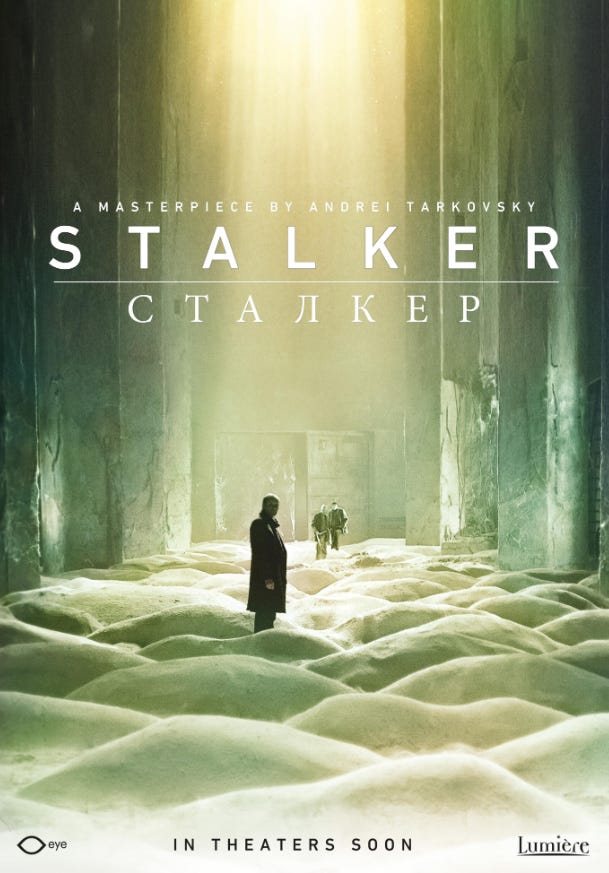
Credit: https://www.imdb.com/title/tt0079944/?ref_=mv_close
Released in 1979, it begins with one of the great science-fiction premises. Somewhere exists a forbidden territory known only as the Zone. At its heart, according to rumour, is a place capable of granting a person’s deepest desire. A man known as the Stalker makes his living illegally guiding people inside.
On one particular journey, he takes with him two men: A Writer and a Professor.
This I guess, is really all anyone should know before seeing it.
Anyone approaching Stalker expecting conventional science fiction is likely to be surprised. There are no spaceships, futuristic cities or elaborate special effects. Tarkovsky is interested in something much stranger: What happens when human beings are confronted with the possibility that their deepest desires may not be the ones they consciously believe themselves to have.
The Zone is one of cinema’s great landscapes. Abandoned buildings, flooded rooms, rusting machinery, overgrown railway tracks and stretches of apparently ordinary countryside acquire an almost supernatural presence. Tarkovsky rarely shows us anything explicitly impossible. Instead, he persuades us that the rules have changed.
The effect is extraordinary.
Much of this comes from Tarkovsky’s approach to time. His camera doesn’t hurry. Shots continue way beyond the point at which most directors would have cut for lunch, allowing us to begin examining the frame rather than merely following the story. Water moves. Grass bends. A face changes almost imperceptibly. The longer we look, the more mysterious ordinary things become.
At nearly three hours, Stalker perhaps demands patience, but its slowness is not emptiness my darlings, it is the mechanism by which the film works. Tarkovsky gradually removes the normal rhythms of cinema until we begin experiencing time alongside the characters, rather than simply observing them.
To be fair, the film’s production history is almost as extraordinary as the finished work.
Tarkovsky originally shot a substantial portion of Stalker with cinematographer Georgy Rerberg, but the footage was reportedly rendered unusable after problems with the film stock and its processing. Exact circumstances remain disputed, but the consequence was catastrophic: Much of the film had to be made again.
For most directors, that might have ended it. But Tarkovsky effectively rebuilt the film.
The rewritten and reshot version became different from what had originally been planned, with Alexander Knyazhinsky taking over as cinematographer. The disaster may ultimately have contributed to the strange concentration of the finished film. What emerged was not simply a replacement for the lost version, but something Tarkovsky had been forced to reconsider almost from the ground up.
The physical locations added another, darker chapter to the film’s history. Much of Stalker was shot around abandoned industrial sites in Estonia, including locations near a polluted river and chemical facilities. Years later, after Tarkovsky, his wife Larisa and actor Anatoly Solonitsyn all died from cancer, sound designer Vladimir Sharun suggested that exposure during the production may have contributed to their illnesses. It has never been conclusively established, but the story has inevitably become part of the mythology surrounding a film in which the landscape itself seems contaminated and dangerous.
At the centre of everything is Alexander Kaidanovsky as the Stalker. His performance is remarkable because there is almost nothing conventionally heroic about him. He is vulnerable, obsessive and exhausted, yet completely transformed by his belief in the Zone. Outside it, he appears diminished. Inside, he has purpose.
Tarkovsky reportedly had a difficult relationship with Kaidanovsky during production, but whatever tensions existed produced an extraordinary performance. The Stalker’s faith is the emotional heart of the film. He guides others towards something he cannot possess himself, while watching them question whether they truly want what they claim to seek.
That is where Stalker becomes much more than science fiction.
The film is filled with images of extraordinary beauty: Water flowing across abandoned objects, vegetation reclaiming industrial ruins, figures lying silently together as the camera passes above them. Tarkovsky makes decay beautiful without romanticising it. The world appears simultaneously ruined and alive.
The sound design is equally remarkable. Mechanical rhythms merge with natural sounds until the boundary between them becomes uncertain. Eduard Artemyev’s sparse electronic score never instructs us what to feel. Instead, sound becomes another element of the Zone itself.
Like much of Tarkovsky’s work, Stalker is concerned with faith - not necessarily religious faith, although that is certainly present, but the human need to believe that something exists beyond the visible world. Its characters want proof, yet proof would somehow destroy the very thing they are searching for.
More than forty years later, Stalker has lost none of its power. If anything, its abandoned industrial landscapes and exhausted characters feel even more contemporary now.
A film then about desire, belief, despair - and the terrifying possibility of getting exactly what we truly want.
Tarkovsky doesn’t explain the Zone.
He does something far more powerful.
He takes us in.
Well, it’s Tarkovski, you see. Top Bins.