

Persona
Ingmar Bergman, 1966

Some films seem to burrow directly into the subconscious. More than half a century after its release, Persona remains one of the rare films that still feels genuinely unsettling - not because of what happens, but because of what it suggests about who we are when all the performances fall away.
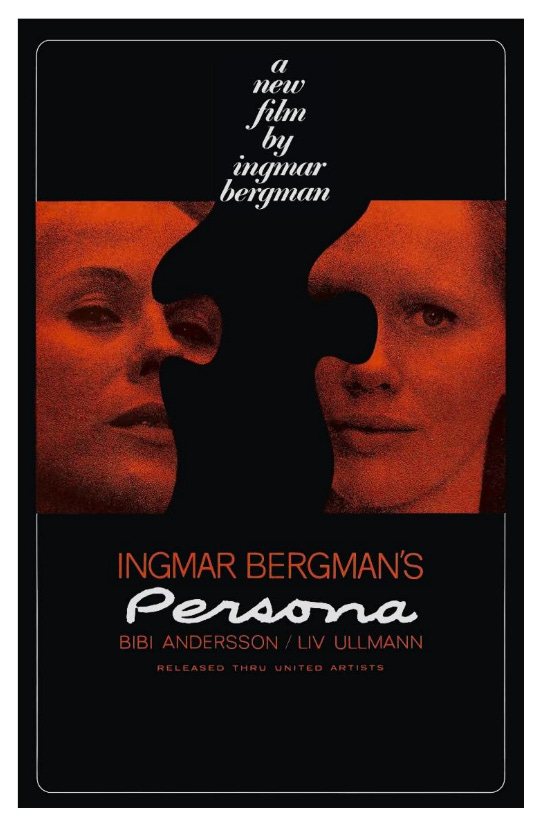
Credit: https://www.imdb.com/title/tt0060827/?ref_=mv_close
The premise is deceptively simple. A celebrated actress suddenly stops speaking. Sent to recover in an isolated seaside house, she is accompanied by a young nurse whose easy confidence gradually begins to fracture. What follows is less a conventional narrative than a slow psychological collision, with the boundaries between the two women becoming increasingly difficult to distinguish.
What makes Persona remarkable is how contemporary it still feels. Long before social media avatars, curated identities and online personas became everyday concepts, Bergman was asking whether any of us possesses a fixed self at all. The film proposes that personality may be little more than a series of masks worn so often that we mistake them for reality.
Behind the camera, Bergman was experiencing a crisis of his own. Following illness and exhaustion, he found himself questioning both his work and the possibilities of cinema itself. Rather than hide that uncertainty, he built it directly into the film. Persona begins by exposing the machinery of filmmaking - projectors, film strips, flashes of imagery - almost daring the audience to remember they are watching an illusion. Yet the deeper the film goes, the more emotionally real it becomes.
The collaboration between Liv Ullmann and Bibi Andersson is among the finest ever captured on screen. Bergman was fascinated by faces, and few directors have photographed them with such intensity. Their performances are built from glances, hesitations and tiny shifts in expression. At times it feels as though Bergman is conducting a scientific experiment, placing two human beings under a microscope and observing the subtle transfer of emotion between them.
Much of the credit belongs to cinematographer Sven Nykvist, whose black-and-white photography is astonishing in its simplicity. Light and shadow become narrative tools. Faces emerge from darkness as though being created in front of us. The famous images in which the two women’s features seem to merge have lost none of their power, not because of technical trickery, but because they visualise the film’s central obsession: where does one person end and another begin?
Watching Persona today, it’s easy to see its influence stretching across decades of cinema. Echoes appear in the work of David Lynch, Robert Altman, Darren Aronofsky and countless others. Yet imitation has never diminished the original. If anything, it reinforces how far ahead of its time Bergman was.
What is perhaps most impressive is that, despite its reputation as a difficult arthouse landmark, Persona never feels academic. It is mysterious, certainly, but it is also deeply emotional. Beneath the formal experimentation lies a profound fear of loneliness and disconnection. The film asks whether genuine intimacy is possible, or whether we are forever trapped behind carefully constructed versions of ourselves.
Many directors have made great films. A handful have changed the language of cinema. With Persona, Bergman managed something even rarer: He created a film that still feels as though it came from the future.
Not every viewer will understand it in the same way. That is part of its enduring fascination. Like a dream recalled imperfectly the next morning, Persona resists definitive interpretation. It lingers instead as a feeling - strange, haunting and impossible to shake.
Few films demand so much from an audience. Even fewer reward that investment so completely.