

Moneyball
Bennett Miller, 2011

Continuing my foray into great films you may’ve missed…
Directed by Bennett Miller and anchored by a standout performance from Brad Pitt as Billy Beane, the film takes what could easily be an inside-baseball slog and turns it into something unexpectedly gripping. Based on Moneyball: The Art of Winning an Unfair Game by Michael Lewis, it tells the story of how the under-resourced Oakland Athletics used data, analytics and contrarian thinking to level the playing field.
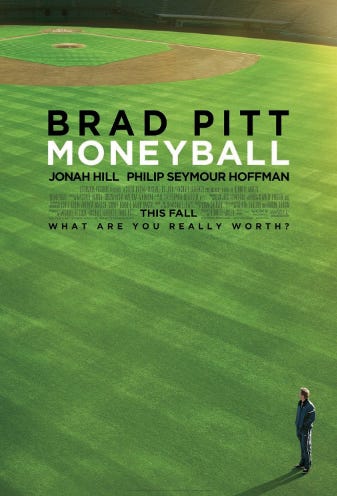
Credit: https://pro.imdb.com/title/tt1210166/?ref_=instant_tt_1&q=moneyball
What impresses is how the film transforms what is essentially a board-room, spreadsheet-driven story into something dramatically compelling. It’s not about home-runs (even though baseball supplies the backdrop) – it’s about value, system change, risk, and character. The screenplay (by Aaron Sorkin, Steven Zaillian and Stan Chervin) mixes smart, sharp dialogue with emotional stakes.
Pitt carries the film with quiet intensity; Jonah Hill as the analyst (“Peter Brand”, fictionalised) also makes a strong case for the “nerd” as protagonist in a sports film, but also a superb star turn from one of my favourite actors, Phillip Seymour Hoffman as Coach. The result: a sports movie and a business-innovation story. Critics responded accordingly: the film currently stands as one of the best of its kind.
It shows how you can take a domain that’s intrinsically technical (analytics, front-office baseball) and turn it into human drama.
The journey from book to screen was neither easy nor clean. The film’s rights were acquired by Columbia Pictures (Sony) and the early script was by Stan Chervin. At one point Steven Soderbergh was attached as director and had developed a rather unconventional vision - mixing real-players, documentary elements, heavy inside-baseball talk.
Studio execs balked. The shoot was delayed just five days before start date because of disagreement over tone. Eventually, Bennett Miller stepped in, Aaron Sorkin re-wrote, and the project found its form.
The film used real baseball stadiums (e.g., Oakland–Alameda County Coliseum) and actual fans - one recounts being an unpaid extra in the background of game-scenes shot in Summer 2010.
Moneyball is a high-water mark for sports dramas — smart, emotionally grounded, and well-crafted. It doesn’t rely on spectacle or clichés (big stadium battle scenes, crowd roars) so much as on ideas and character.
The film inevitably takes liberties with characterisations, for example, the antagonistic relationship between Beane and scout Grady Fuson was exaggerated for dramatic effect.
You could argue some of the drama feels a little tidied for Hollywood (so less mess than real life), but that’s not necessarily a flaw, simply an informed trade-off. For anyone wanting to see how to turn a niche real-world story into a compelling film, this is a masterclass.
On a personal note though, it’s something else.. all this is great - don’t get me wrong, but it’s Miller’s ability, his confidence in allowing the acting to breathe, secure in the knowledge the story is there and so the film’s rhythm too (obviously, you need a quality cast). It’s minor, and yet so massive in these times of fast edit, & get on with it…
But also his economy of shot. He chooses a frame with such skill and deliberation, allowing the entire narrative to unfold in the most unfussy of ways. I have an issue with directors who insist on getting in the way of the story: In disappearing, Miller is a Class Act.
Anatomy of a Flop 050
Nik Powell - Producer at Scala Pictures and famous for The Crying Game, among many others.. later Director of the National Film & Television School, whom I met on my extensive voyage around the making of Angels…
