

Midnight Run
Martin Brest, 1988

There’s a particular confidence to Midnight Run that still feels rare. It doesn’t announce itself as a classic; it just gets on with the job, trusts its rhythms, and lets character do the heavy lifting. On paper it’s a chase movie - bounty hunter escorts white-collar criminal across America - but in execution it’s a study in temperament, timing, and the slow erosion of professional armour.
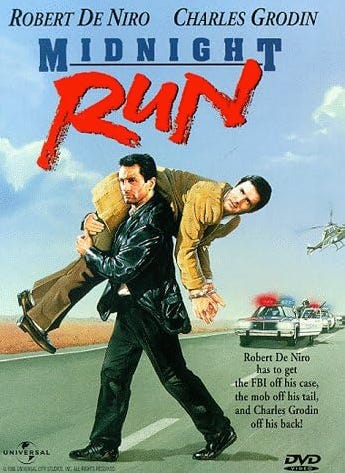
Credit: https://www.imdb.com/title/tt0095631/?ref_=mv_close
At the centre is Robert De Niro, playing Jack Walsh, an ex-cop turned bounty hunter whose competence is absolute and whose bitterness is carefully rationed. This arrived right in the middle of De Niro’s most mythologised period, yet it’s one of his least showy performances of the decade. No grand monologues, no operatic violence. Instead: clipped irritation, wary intelligence, and an unexpectedly light comic touch. It’s a reminder that his range was never just about transformation - it was about control.
Opposite him, Charles Grodin delivers one of the great deadpan performances in American comedy. Jonathan “The Duke” Mardukas isn’t written as a clown; he’s written as a man whose ethical compass is intact but inconvenient. Grodin plays him not for laughs but for truth - the humour arises because he refuses to bend, refuses to panic, refuses to perform masculinity on cue. His calm dismantles Walsh’s aggression scene by scene. The film understands that the most destabilising force in a macho system is not violence, but civility.
What elevates Midnight Run beyond genre is the hand guiding it. Martin Brest had an unusually precise sense of tone, and here he threads it perfectly. The film moves effortlessly between action, comedy, and melancholy without underlining the transitions. Brest’s direction is deceptively simple: Clean coverage, disciplined pacing, an insistence on letting scenes play out rather than punchlines being chased. He knows exactly when to hold back. That restraint is what gives the film its longevity.
There’s a strong sense of physical geography too - trains, buses, planes, diners, small towns - all used not as spectacle but as friction. Every change of location introduces a new constraint, another small humiliation or compromise. The road movie structure isn’t about freedom; it’s about attrition. By the time Walsh and Mardukas reach Los Angeles, the journey has stripped Walsh of his professional detachment, and forced him to confront what he’s lost in the process of “doing his job”.
Behind the scenes, the film’s tone was not a foregone conclusion. De Niro was coming off an intense run of dramatic roles, and there was genuine uncertainty - including from Universal - about whether he could anchor a broad action-comedy. Brest, however, pushed hard for a lighter register, encouraging De Niro to lean into irritation rather than menace. The result is crucial: Walsh is dangerous, yes, but never cartoonishly so. His violence is functional, not expressive.
Grodin, for his part, was famously resistant to the studio’s desire to soften or embellish his character. He argued that Mardukas should remain morally consistent, even when it made him less “likeable” in conventional terms. That insistence paid off. The character works because he isn’t trying to win us over; he’s simply right. In a genre built on swagger, Midnight Run quietly sides with principle.
Another often-overlooked element is Danny Elfman’s score - playful without being intrusive, propulsive without dictating emotion. It gives the film buoyancy while leaving room for stillness. Brest understood that comedy dies when it’s over-scored, and the restraint here is part of the film’s overall confidence.
And it’s not just the leads, the cast throughout is impeccable. Yaphet Koto as the FBI on his tail, Joe Pantaliano as the exasperated bail-bondsman, the wonderful and much-missed Dennis Farina as the villain of the piece, but all the bit players that fill in the gaps too.
What ultimately distinguishes Midnight Run is that it believes in decency without sentimentalising it. Walsh’s final decision isn’t framed as heroic redemption; it’s framed as the smallest possible act of repair. The film doesn’t suggest the system will change. It suggests that one man, briefly, chooses not to be crushed by it.
In an era saturated with buddy movies that mistake volume for chemistry, Midnight Run endures because it understands contrast. Noise needs silence. Aggression needs refusal. Speed needs patience. Brest, De Niro, and Grodin each knew exactly what not to do - and that discipline is why the film still runs so smoothly, decades later.
Anatomy of a Flop 062
