

Léon
Luc Besson, 1994

Few films divide opinion quite like Léon: The Professional. For some, it’s one of the great action films of the 1990s. For others, its central relationship remains deeply uncomfortable. Both reactions are understandable, and perhaps that’s why the film continues to provoke discussion more than thirty years after its release.
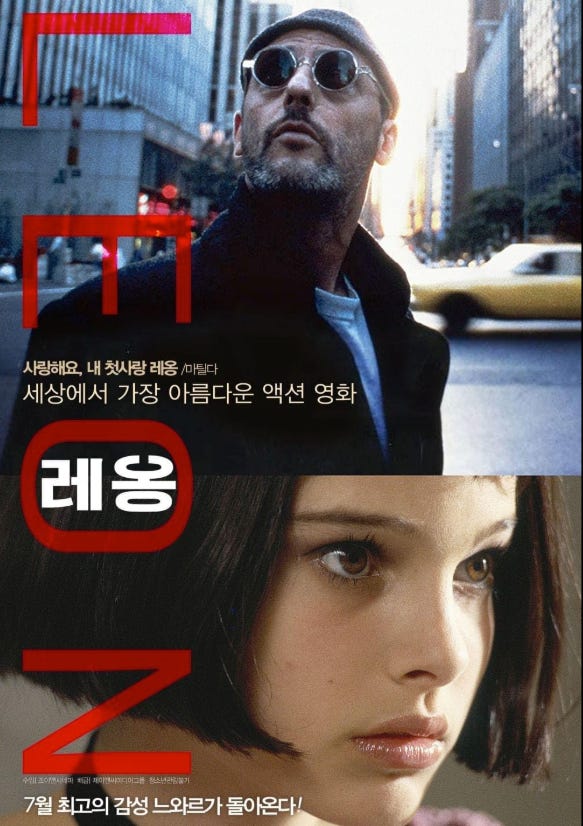
Credit: https://www.imdb.com/title/tt0110413/?ref_=nv_sr_srsg_0_tt_1_nm_7_in_0_q_leon
Written and directed by Luc Besson, Léon follows a solitary hitman living an almost monastic existence in New York. His ordered life is shattered when twelve-year-old Mathilda survives the murder of her family and seeks refuge in his apartment. What follows is part revenge thriller, part coming-of-age story and, at its heart, an unlikely tale of two profoundly lonely people.
The genius of the film lies in its simplicity.
Léon isn’t a superhero. He’s emotionally stunted, barely literate, socially awkward and almost childlike in many respects. Assassination is the one thing he understands. Remove the violence and he’s almost incapable of navigating ordinary human relationships.
Jean Reno plays him with extraordinary restraint. Reno says very little throughout the film, relying instead on posture, hesitation and tiny shifts in expression. Lesser actors might have turned Léon into a cool, untouchable professional. Reno makes him vulnerable, even innocent. His affection for his pot plant - one of the film’s recurring visual motifs—tells us almost everything we need to know about a man with no roots of his own.
Then there’s Natalie Portman.
Making her screen debut at just twelve years old, Portman delivers one of the most astonishing first performances in cinema history. Mathilda is angry, traumatised, manipulative, funny and desperately in need of love. Portman never plays her as a victim. Instead, she captures the confusing bravado of a child forced to become an adult overnight.
The relationship between Léon and Mathilda remains the film’s most debated aspect. Besson deliberately allows emotional ambiguities to surface, and some moments feel distinctly uneasy today. Yet Jean Reno’s performance continually steers the relationship back towards protection rather than fulfilment. Léon himself appears incapable of responding to Mathilda’s confused attempts to define their bond, making the film ultimately less about romance than about two damaged souls finding a version of family.
Towering over them both is Gary Oldman as DEA agent Norman Stansfield.
It’s one of the great movie villains.
Oldman doesn’t merely chew the scenery—he devours it whole. Stansfield is cultured, intelligent, addicted to prescription drugs and terrifyingly unpredictable. One moment he speaks almost in whispers; the next he erupts into explosive violence. The famous cry of “EVERYONE!” has become cinematic folklore, but what makes the performance so memorable isn’t the volume. It’s the complete absence of emotional logic. You never know what Stansfield will do next, and neither do the characters around him.
Visually, the film is immaculate. Cinematographer Thierry Arbogast gives New York a strangely European texture. Apartments feel claustrophobic, corridors become battlegrounds and sunlight rarely offers comfort. Besson stages action with remarkable clarity, avoiding frantic editing in favour of precise geography and clean visual storytelling. Every shoot-out is easy to follow because every frame has been carefully designed.
Behind the scenes, the project has an unusual history. Besson reportedly wrote the screenplay during a break in production on The Fifth Element, expanding ideas from his earlier film La Femme Nikita, where Reno had appeared as a cleaner known simply as Victor. That influence is obvious, but Léon becomes something much richer than a professional killer thriller.
The score by Éric Serra mirrors the film beautifully, shifting effortlessly between tenderness, melancholy and sudden bursts of tension without overwhelming the performances.
If there’s a weakness, it’s that Besson occasionally indulges in stylisation at the expense of emotional credibility. A handful of scenes flirt with caricature, particularly around Stansfield’s excesses, and some viewers will never be able to separate the film from the controversies surrounding Besson’s personal life. That’s a legitimate consideration, even if the work ultimately has to stand on its own merits.
What has endured is the emotional core.
Strip away the assassins, corrupt police officers and action set pieces, and Léon is about two isolated people teaching one another how to live. Mathilda learns discipline and patience. Léon discovers responsibility, affection and, finally, sacrifice.
It’s an action film with the heart of a fairy tale, albeit one filtered through grief and violence. Beautifully acted, visually elegant and emotionally resonant, Léon remains one of the defining films of 1990s European-influenced cinema - and the moment the world discovered Natalie Portman.