

Incendies
Denis Villeneuve, 2010

Incendies is the kind of film that does not merely tell a story. It bears down on you. I feel I need to stand up at this point and make it known ~ I’m in a minority when I admit to the fact I’m not the greatest fan of this director’s work.. but credit where credit’s due, Denis Villeneuve’s 2010 adaptation of Wajdi Mouawad’s play is a work of enormous moral weight: Fierce, grief-stricken, and controlled with a kind of terrible precision. It is not a war film in the conventional sense, and not really a mystery either, though it moves with the force of both.
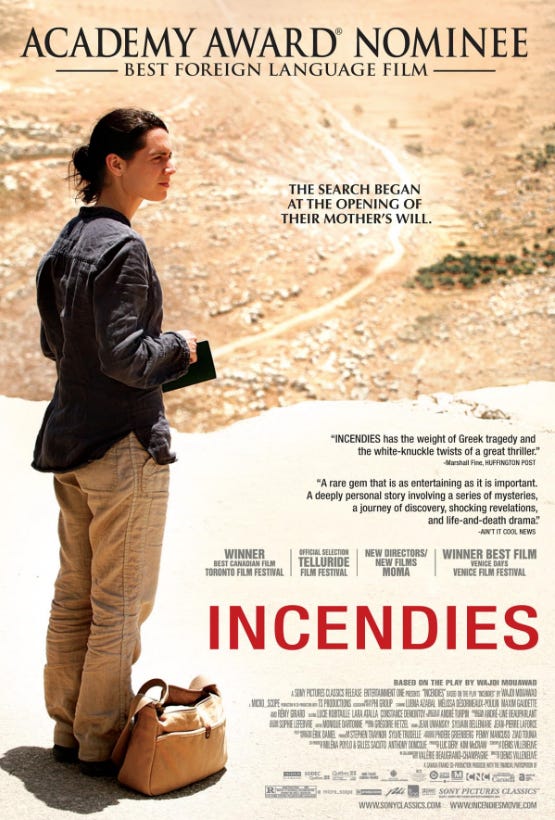
Credit: https://www.imdb.com/title/tt1255953/?ref_=mv_close
What it is, above all, is a reckoning - with history, with family, with memory, and with the damage violence leaves behind long after the gunfire stops. It was adapted from Mouawad’s stage play and went on to become Canada’s Oscar nominee for Best Foreign Language Film after premiering at Venice and Toronto.
What makes Incendies so gripping is that Villeneuve never treats political violence as backdrop. He understands that war invades the private realm first: the body, the home, the bloodline, the stories families tell and refuse to tell. The film is interested in inheritance, but not in the cosy sense. It asks what children receive from their parents besides love: silence, trauma, unfinished history, rage, endurance.
It is a film about how the past does not stay buried because it has been processed; it stays buried because people are too broken to speak it aloud. That is where the film gets its charge. Not from spectacle, but from the collision between public catastrophe and intimate human cost.
There is also something bracingly unsentimental about it. Incendies is full of pain, but it is not manipulative. Villeneuve directs with a severe, almost ritual clarity. He strips things back. He trusts faces, landscapes, sound, duration. He lets scenes breathe just long enough for dread to gather. This is one of the reasons the film hits so hard: it refuses easy emotional release. It is never trying to flatter the audience with its seriousness. It simply insists that you look.
A major reason it works so powerfully is Lubna Azabal, who gives the film its soul and its steel. Villeneuve has said the central role was the hardest to cast and that he initially thought he might need more than one actress to play it across different stages; instead, Azabal’s screen test convinced him she could carry the full emotional and physical burden herself. He described her as having the strength and inner fire the role required. He was right. Her performance is not decorative, not “showy”, not built around actorly tricks. It is elemental. She gives the film its moral gravity.
Thematically, Incendies is operating on several levels at once. It is about maternal sacrifice, certainly, but also about identity as something fractured by history rather than cleanly inherited. It is about the limits of religion, nationalism and tribal loyalty when set against actual human suffering. It is about how hatred reproduces itself through institutions, mythologies and revenge, until individuals barely know where personal grief ends and collective madness begins.
And yet, for all its darkness, the film is also about courage - not macho courage, not cinematic heroism, but the far harder kind: the choice to keep going, to keep looking, to endure knowledge rather than run from it.
There is a reason Villeneuve’s later films became so internationally dominant. You can already see the architecture here: the command of scale, the seriousness, the appetite for moral extremity, the ability to fuse emotional intimacy with formal control. But Incendies may still be one of his rawest works. It has less polish than the later films, maybe, but more exposed nerve. It feels made by someone who had something urgent to excavate, not merely something impressive to stage.
As for background, the film was adapted from Mouawad’s play, and while the country in the story remains unnamed, the material is widely understood to be shaped by the Lebanese civil war and related histories of sectarian conflict and political imprisonment. Villeneuve also spoke about wanting to create a dialogue between past and present, which is exactly what gives the film its haunted feeling: history is never past here, only waiting to be recognised.
Production-wise, the film was shot largely in Canada with part of the location work done in Jordan, helping Villeneuve evoke a war-scarred landscape without pinning the story too narrowly to one literal map.
No spoilers, so I will leave the mechanics of the plot alone. But Incendies is one of those rare films where the unfolding is not just clever, but ethically loaded. The further it moves, the more it becomes about the cost of knowing. About whether truth heals, or simply wounds more honestly. About whether family is a shelter or a conduit through which history keeps passing its injuries down.
That is why the film lingers. Not because it is shocking, though it is. Not because it is sad, though it is devastating. It lingers because it understands something ugly and true: that violence does not end when the event ends. It survives in memory, in silence, in children, in names, in the stories people are unable to finish.
Incendies is a punishing film, but a major one. Severe, intelligent, deeply felt. It does not offer comfort. It offers something better: seriousness.
Anatomy of a Flop 069
In conclusion…
