

Ida
Pavel Pawlikowski, 2013

ChatGPT said:
Continuing my foray into great films you may have missed.
Ida works so well because it refuses to perform. No varnish, no emotional hand-holding, no stylistic flourishes conceived to impress you. Pawlikowski pares the film to bone: 4:3, black-and-white, static frames, huge headroom, long quiet stretches. It’s not artiness, it’s discipline. The austerity forces you into the characters’ inner weather, whether you like it or not.
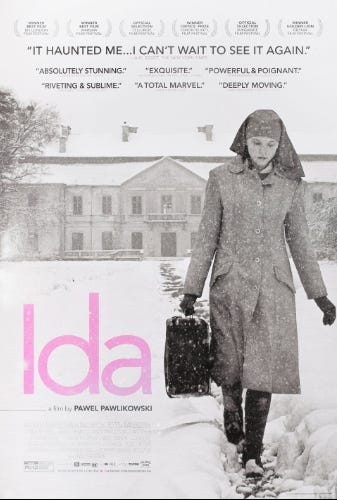
Credit: https://pro.imdb.com/title/tt2718492/?ref_=search_search_search_result_2
The plot is brutally simple. Anna, a sheltered novice nun, is told before taking her vows that she has an aunt. That aunt - Wanda - immediately detonates her identity by revealing she’s Jewish - her name, Ida Lebenstein - her parents killed during the war.
They travel into rural Poland to find out who did it and where the bodies lie. But what the film’s really doing is excavating two lives shaped by opposite forms of isolation: Ida’s monastic insulation and Wanda’s corrosive burden of history.
The emotional force comes from how the two women occupy the frame. Ida is stillness; Wanda, damage. One quietly absorbs, the other lashes out. Their scenes together hold all the tension - religion vs guilt, innocence vs experience, denial vs memory. The film never raises its voice, yet every beat hits like a hammer.
Behind the scenes, this starkness wasn’t an aesthetic whim, Pawlikowski mining his own family history - Wanda is drawn heavily from his aunt, a former Stalinist prosecutor whose past was a wound no one talked about. That’s why the character feels lived, rather than written.
The visual style came from the director’s memory of post-war Polish photography: Harsh contrasts, narrow frames, a world that feels half-erased. Shooting in 4:3 and monochrome wasn’t nostalgia; it was meant to evoke the lost, damaged archival images he was so familiar with.
The production itself was stripped-back. Interiors were lit with natural or single-source light. The DP change midway through the shoot - Łukasz Żal taking over when the original DP fell ill - accidentally locked in the final aesthetic. Żal leaned into simplicity and negative space out of sheer practicality, and it worked.
The odd framing with tons of headroom was intentional: Pawlikowski wanted the “weight above them” - God, absence, history - to hang over every scene.
Agata Trzebuchowska, who plays Ida, wasn’t even an actor. Found in a café, chosen because she had the presence and silence the film needed, not a repertoire of expressions, or the overt knowledge borne of training.
Shot fast, a small crew and modest budget. No safety net, no excess takes. And that leanness bleeds into the final movie: ninety minutes with no fat.
Ida succeeds because it doesn’t lecture or dramatise. It just stares at Poland’s moral knots - complicity, silence, survival - and forces you to sit in the discomfort. A quiet film that hits harder than most “big” ones, because it refuses to blink.
Winning a slew of awards across the festival world, it also took home the Best Foreign Language Oscar.
Anatomy of a Flop 053
