

Hell or High Water
David Mackenzie, 2016

There are few modern films that understand America as instinctively as Hell or High Water. On its surface it’s a bank-robbing thriller. Underneath, it’s a western. Beneath that, it’s an obituary for a version of America that quietly disappeared while nobody was looking.
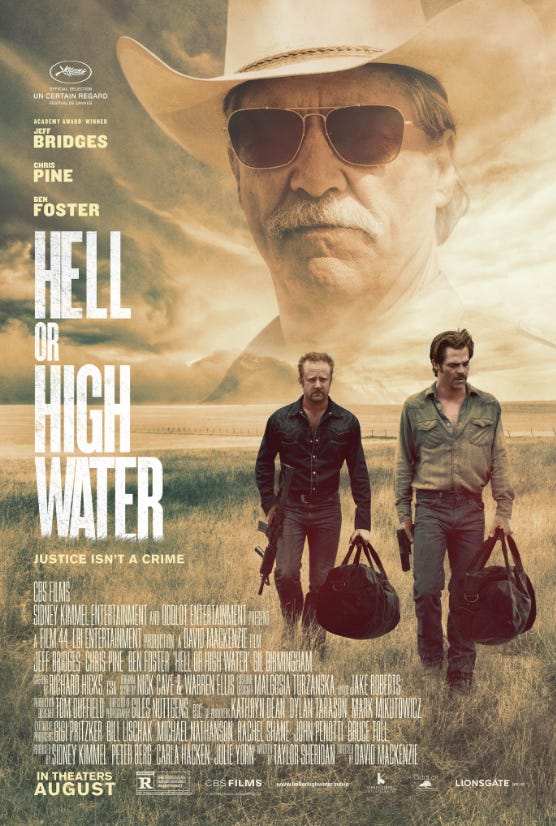
Credit: https://www.imdb.com/title/tt2582782/?ref_=nv_sr_srsg_0_tt_8_nm_0_in_0_q_hell%20or%20high%20water
Directed by David Mackenzie and written by Taylor Sheridan, the film follows two brothers robbing branches of the very bank threatening to repossess their family ranch. Chasing them across West Texas is an ageing Texas Ranger approaching retirement. It sounds familiar, almost archetypal, because that’s precisely the point. Sheridan lifts the bones of the classic western and transplants them into a world where horses have become pickup trucks and the new frontier is debt.
The brilliance lies in its restraint. This isn’t a film interested in elaborate heists or clever twists. Every robbery is functional, almost mundane. The suspense comes not from whether the brothers will get away, but from the sense that everyone involved is trapped inside an economic system that’s already decided their fate. Crime becomes less a choice than a symptom.
Sheridan’s screenplay is among the finest of the past decade. His dialogue feels overheard rather than written - dry, economical and often very funny. People don’t explain themselves because they don’t need to. Years of history sit between every line. It’s the kind of writing that trusts an audience to fill in the gaps.
Visually, Mackenzie understands that landscape is character. The vast Texas plains aren’t romanticised. Cinematographer Giles Nuttgens fills the frame with abandoned storefronts, shuttered businesses, fading billboards and endless skies. Every mile suggests somewhere prosperity once existed. The film rarely points to poverty directly; it simply lets you absorb it from the world surrounding the characters.
The performances are exceptional across the board.
Chris Pine delivers perhaps the finest performance of his career. Better known at the time for larger studio films, he strips away every trace of movie-star confidence to play Toby, a quiet man carrying the weight of generations of disappointment. His silence often says more than pages of dialogue could.
Alongside him, Ben Foster is magnetic as Tanner, volatile, reckless and permanently on the edge of self-destruction. Foster has always excelled at characters who seem capable of exploding without warning, but there’s an aching loyalty beneath Tanner’s violence that stops him becoming a caricature. The chemistry between the two feels completely lived in. You believe they’re brothers from the first scene.
Then there’s Jeff Bridges, enjoying one of those late-career roles that reminds you just how good he is. As Ranger Marcus Hamilton, he carries decades of experience with effortless ease. His constant needling of his partner, played beautifully by Gil Birmingham, provides much of the humour, but Sheridan is too smart to leave those exchanges uncomplicated. The jokes gradually reveal uncomfortable truths about friendship, race and ageing, culminating in moments that are unexpectedly moving.
One of the film’s greatest strengths is that nobody is entirely innocent and nobody is entirely guilty. The banks exploit ordinary people. The brothers commit violent crimes. The law pursues justice while quietly recognising why the crimes occurred in the first place. Sheridan refuses to hand the audience easy moral positions.
Behind the scenes, the production embraced authenticity over spectacle. Much of the film was shot in real West Texas locations, allowing the weathered towns and enormous landscapes to become integral to the storytelling rather than decorative backdrops. Mackenzie avoids flashy direction, understanding that confidence often means knowing when not to draw attention to yourself. Even the action scenes are short, messy and frighteningly plausible.
The score by Nick Cave and Warren Ellis perfectly matches the film’s melancholy rhythm. Sparse, mournful and patient, it never tells you what to feel. It simply hangs over the landscape like another layer of dust.
Perhaps the film’s greatest achievement is that it feels timeless already. Although rooted firmly in the aftermath of the 2008 financial crash, its themes have only become more relevant. Corporate ownership expands. Rural communities shrink. Wealth concentrates elsewhere. The frontier myth survives, but the enemy is no longer the wilderness. It’s paperwork.
The title promises a thriller, and it certainly delivers one. But Hell or High Water is something richer: A modern western that understands the mythology of America while quietly dismantling it. It asks what happens when honest work is no longer enough, when inheritance becomes debt, and when survival itself begins to look like a crime.
Few films balance character, tension, humour and social observation with such effortless confidence. It’s one of the defining American films of the 21st century, even if it took a Scotsman to direct it.