

Five Easy Pieces
Bob Rafelson, 1970

Some films arrive with a bang. Others drift in quietly, carrying a truth so uncomfortable and recognisable that it lingers long after the credits. Five Easy Pieces belongs firmly in the latter category. More than fifty years after its release, it remains one of the defining American films of the 1970s: deceptively simple on the surface, devastating underneath.
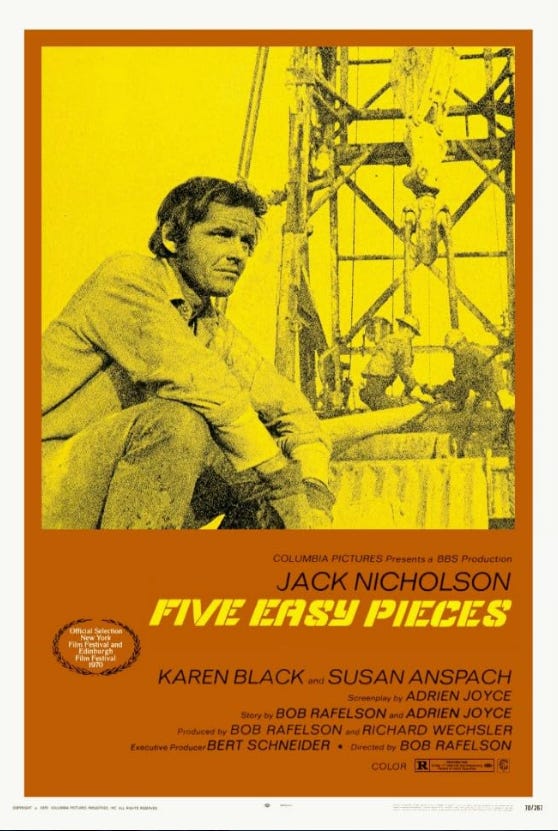
Credit: https://www.imdb.com/title/tt0065724/?ref_=mv_close
At the centre is Bobby Dupea, played by a young Jack Nicholson in what was arguably the performance that transformed him from promising actor into movie star. Bobby works rough manual jobs, drifts through relationships and seems perpetually dissatisfied, though he struggles to articulate why. The film follows him through a series of encounters and decisions that gradually reveal the fault lines beneath his restless existence.
What makes Five Easy Pieces so remarkable is its refusal to provide easy answers. This isn’t a film interested in redemption arcs or neat psychological diagnoses. Instead, director Bob Rafelson presents a man trapped between worlds, unable to commit to either. The result feels startlingly modern. Bobby’s crisis isn’t one of survival but of identity. He has choices available to him, yet every choice seems to deepen his unhappiness.
Behind the camera, the film emerged from one of the most fertile creative partnerships of the New Hollywood era. Rafelson and Nicholson had already collaborated on Head and would later work together on The King of Marvin Gardens. Here they found the perfect vehicle for Nicholson’s particular screen presence: intelligent, unpredictable, charismatic and faintly dangerous. Long before the actor became a cultural institution, you can see the raw electricity that made audiences unable to look away.
The screenplay by Carole Eastman deserves equal praise. The dialogue feels effortlessly natural while quietly exposing class tensions, family expectations and personal disappointment. Scenes often begin in one emotional register and end somewhere entirely different. Characters reveal themselves not through speeches but through hesitation, awkwardness and things left unsaid.
The film is also an extraordinary snapshot of America at the turn of the decade. The optimism of the 1960s is fading, replaced by uncertainty and disillusionment. Unlike the larger, louder counterculture films of the period, Five Easy Pieces focuses on something more intimate: the loneliness that can exist even when freedom appears limitless.
Several moments have become legendary, not because they are dramatic in a conventional sense but because they capture frustration with almost unbearable precision. Rafelson’s direction understands that life’s defining moments are often small, messy and unresolved. The camera observes rather than judges.
Nicholson dominates the film, but the supporting cast is equally impressive, particularly Karen Black, whose performance brings warmth and vulnerability to a role that lesser films might have treated as a caricature. The relationships feel lived-in, complicated and painfully human.
What endures most is the film’s honesty. Five Easy Pieces understands that intelligence doesn’t guarantee happiness, talent doesn’t guarantee purpose and freedom doesn’t guarantee fulfilment. Those ideas are as relevant now as they were in 1970.
At one point, Rafelson knew only what he didn’t want. Nicholson told him to leave him with the camera, alone. He did so. The results were groundbreaking for the time, in terms of male vulnerability on screen. For me, films are always about performance.
Many films explore the search for meaning. Few do so with such precision, compassion and lack of sentimentality. More than half a century later, Five Easy Pieces remains one of the essential works of American cinema: A road movie, a character study and a quietly devastating portrait of a man who can never quite find his place in the world.