

Bullhead
Michaël R. Roskam, 2011

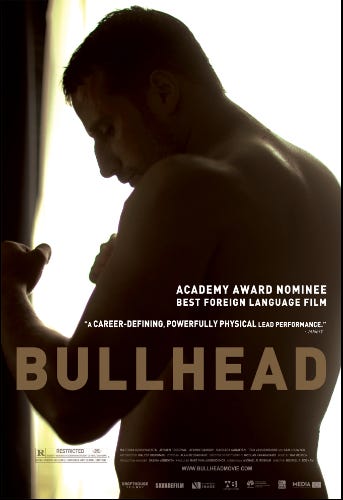
Some films arrive fully formed, as if carved out of the Belgian landscape they depict. Bullhead feels like that - not so much made, as unearthed. Michaël R. Roskam’s 2011 debut is a bruised, slow-burning fable about men, silence, and the bodies they build to hide what they cannot express. Not to shortchange it in the slightest, like Taxi Driver, I would describe it as a very male film, a film that exists in its own moral weather, heavy with guilt, tenderness, and rage.
Credit: https://imdb.com/title/tt1821593/images
Set in the muddy, overcast flatlands of Limburg, the film unfolds within the illegal hormone trade - farmers and fixers juicing cattle, and themselves, to keep pace with a market that rewards only muscle. But what begins as a crime drama soon mutates into something rawer, stranger, and far more personal. Beneath the machinery of crime lies a man imprisoned in his own flesh: Jacky Vanmarsenille, played with great intensity by Matthias Schoenaerts.
Roskam wrote the script over several years, drawn to the world he knew from his youth in rural Belgium. He’d read a news story about a veterinarian killed in the hormone mafia wars and began sketching a film that would explore not just that underworld, but what it meant to live by strength alone. He worked on it obsessively, rewriting until he found something mythic under the grime - a tragedy disguised as a gangster film.
For Schoenaerts, Bullhead was a turning point. He gained over 60 pounds of muscle for the role, but it wasn’t vanity or show. As he’s said in interviews, the transformation was about embodying a man who’d built himself into a shell. He wanted to feel what it was like when your own body becomes a prison: When the thing that protects you also isolates you. That discipline - physical, emotional, monastic - seeps into every frame. His Jacky is enormous, yet fragile; a creature of immense presence who seems to shrink under the weight of memory.
Roskam directs with remarkable patience and control. His camera lingers on faces and landscapes as if they’re part of the same organism - everything damp, cold, and quietly suffocating. There’s very little exposition. Meaning comes through gesture, repetition, and silence. The tone is closer to Greek tragedy than noir, yet never feels contrived. Each scene hums with authenticity, drawn from real rural textures: the smell of cattle sheds, the low thud of machinery, the quiet desperation of men bound by pride and family.
It’s perhaps telling also that Schoenaerts and Roskam had worked together previously on a Short about seven-years earlier and this is perhaps what injected the additional trust and commitment for Schoenaerts to go all-in, both in bulking-up for the role, but also to plumb the depths of vulnerability the part relied on, if it was going to work at all.
When Bullhead premiered at Berlin, it marked both Roskam and Schoenaerts as major new talents. The film went on to earn an Academy Award nomination for Best Foreign Language Film launching Schoenaerts’ international career - Rust and Bone, The Drop, Far from the Madding Crowd, Disorder - yet he’s often said that Bullhead remains his most personal work. It’s the film, he once noted, “that taught me everything - about discipline, about pain, about how far you can go when the story demands it.”
Rewatching it now, what lingers isn’t the plot, but the feeling: A man trapped inside the myth of his own toughness, flailing against the only version of himself he knows how to be. Bullhead is about the violence of that entrapment - not just in one man, but in a culture that prizes muscle over vulnerability, loyalty over truth.
The enduring success and power of Roskam’s film is that he succeeded in delivering both the intimate and the monumental. It stares down male brutality and finds, beneath the surface, something deeply sad and human. By the time it’s over, you’re left with the sense of having witnessed a kind of metamorphosis ~ a man breaking himself open to survive the very armour that once kept him safe.
It’s that contradiction, strength as weakness, power as pain, that gives Bullhead its terrible beauty.
Not a film that asks to be liked ~ it asks to be felt. And once you do, it’s hard to shake off.
Anatomy of a Flop 0048
So, still working out the way through to the finish line when money is beyond tight. It was important to keep all parties informed of the situation.
