

Boogie Nights
Paul Thomas Anderson, 1997

There are films about outsiders and films made for outsiders. Boogie Nights is both.
On paper, a story about the pornography industry in California during the 1970s and early ‘80s. In practice, about loneliness ~ porn merely the setting. The real subject is a group of damaged people who create an unconventional family because none of them have found one anywhere else.
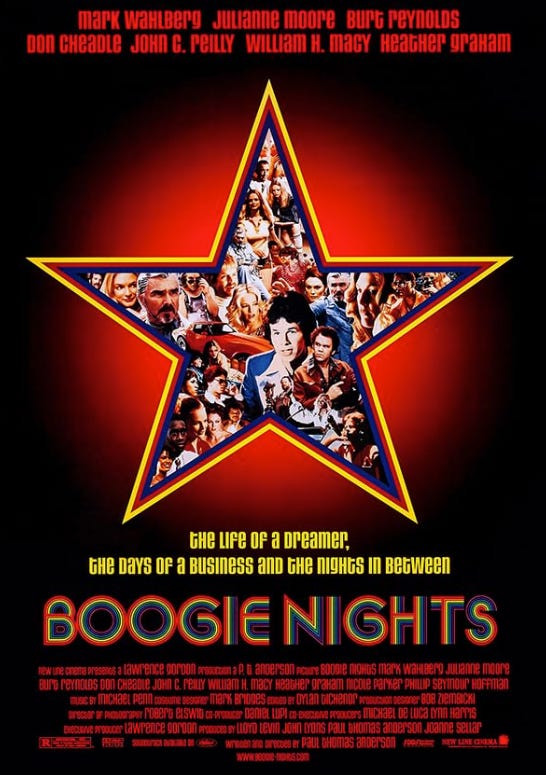
Credit: https://www.imdb.com/title/tt0118749/?ref_=nv_sr_srsg_0_tt_7_nm_1_in_0_q_boogie%20nights
It was only Paul Thomas Anderson’s second feature, yet it announced the arrival of one of the great American directors. Barely into his mid-twenties when he made it, Anderson displayed a confidence that many filmmakers never acquire. The film is sprawling, funny, heartbreaking and technically assured, but never feels as though it’s showing off. Every flourish is rooted in character.
Loosely inspired by the life of John Holmes, the story follows Eddie Adams, reinvented as Dirk Diggler after being discovered by adult filmmaker Jack Horner. His meteoric rise mirrors the industry’s own golden age, before ego, drugs and changing technology slowly tear everything apart.
Mark Wahlberg has rarely been better. Dirk begins as an eager teenager desperate for approval, confusing admiration with love. Wahlberg understands that beneath Dirk’s confidence sits a frightened boy who has never quite grown up.
But this isn’t really Dirk’s film, it’s an ensemble piece and perhaps one of the richest the US ever assembled.
Burt Reynolds brings enormous warmth and authority to Jack Horner. He’s a director, producer and father figure rolled into one - a man convinced that what he’s making matters artistically, even as the world increasingly dismisses it. Reynolds famously clashed with Anderson throughout production and reportedly hated making the film, yet the performance earned him an Oscar nomination and remains one of the finest of his career.
Julianne Moore is devastating as Amber Waves, searching for the maternal connection denied to her elsewhere, while John C. Reilly, Don Cheadle and William H. Macy each build characters whose lives feel fully formed beyond the edges of the frame.
Then there’s Philip Seymour Hoffman.
His Scotty J. is the film’s quiet masterpiece.
Scotty is awkward, painfully shy and hopelessly in love with Dirk. Lesser films would have played him for laughs or flipped him into stereotype. Anderson and Hoffman do neither. Instead, Scotty becomes the film’s most vulnerable character - a man desperate simply to be seen.
Hoffman was already a remarkable actor, but Boogie Nights was the performance that made audiences truly notice him. Every hesitant smile, every aborted sentence, every nervous glance carries enormous emotional weight. His heartbreaking confession to Dirk, followed by the immediate attempt to laugh it off, remains one of the film’s most painful moments because it captures something painfully recognisable: The humiliation of exposing feelings that aren’t returned.
It’s vintage Hoffman. He never asks for sympathy. He simply inhabits Scotty so completely that sympathy becomes unavoidable.
Watching it now, knowing the extraordinary career Hoffman would go on to have, the performance feels prophetic. Even surrounded by an exceptional cast, your eyes keep drifting back to him.
Behind the camera, Anderson and cinematographer Robert Elswit create one of the most visually exhilarating American films of the 1990s. The legendary opening tracking shot isn’t simply technical bravado; it introduces an entire ecosystem in one fluid movement. Throughout the film, the camera glides effortlessly between characters, reflecting the confidence and optimism of the era.
As the story moves into the 1980s, that visual energy subtly changes. Film gives way to videotape. Colours become harsher. Cocaine erodes relationships and the dream begins to curdle. Anderson never announces the transition - it just seeps into every frame.
The production itself has become part of cinema folklore. Anderson expanded ideas from his teenage mockumentary The Dirk Diggler Story, drawing inspiration from directors such as Martin Scorsese and Robert Altman, yet the finished film never feels like imitation. The influences are visible, but the voice is unmistakably his own.
The genius of Boogie Nights is that it refuses to moralise. It neither celebrates nor condemns the adult film industry. Instead, it asks why these people found more acceptance there than they ever did in the conventional world. Their profession isn’t the point, their need for belonging is.
By the end, what stays isn’t the excess, the parties or the outrageous humour. It’s the fragile bond between people trying to convince themselves they’ve finally found somewhere they belong.
Few films understand loneliness so well while remaining this entertaining. Fewer still manage to make every supporting character feel like the lead in their own story.
For me, that’s what makes Boogie Nights endure (I can’t quite believe it was made back in 1997..). Beneath the disco lights and bravado lies one of the most compassionate American ensemble films ever made.