

Apu Trilogy
Satyajit Ray, 1950's

Great films you may have missed…
The Apu Trilogy - Childhood, Loss and the Shape of a Life
Satyajit Ray emerged from the Bengali cultural renaissance of the mid-20th century to become one of cinema’s most revered humanist filmmakers. Beginning his directing career relatively late, with Pather Panchali, he quickly achieved international acclaim - winning major prizes at Cannes, Venice, and Berlin - and was soon regarded as a central figure of world cinema rather than simply an Indian auteur.
His work combined literary sensitivity, visual restraint, and deep psychological observation, influencing filmmakers as varied as Akira Kurosawa, Martin Scorsese, and Abbas Kiarostami. Beyond directing, Ray composed music, designed posters, wrote fiction, and shaped the modern image of Indian art cinema.
There are films that tell stories, and there are films that seem to quietly observe life unfolding. Satyajit Ray’s Apu Trilogy - Pather Panchali (1955), Aparajito (1956), and Apur Sansar (1959) - belongs decisively to the latter category. Watching them today feels less like encountering a classic and more like discovering a living memory: textured, humane, and deeply attentive to the fragile transitions that define growing up.
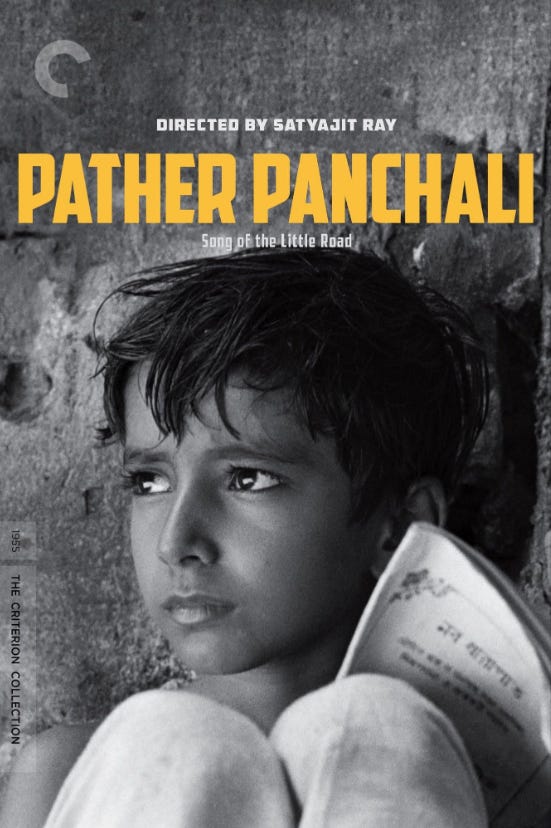
Credit: https://www.imdb.com/title/tt0048473/?ref_=mv_close
Look at that face.
What strikes is the trilogy’s extraordinary patience. Ray allows time and environment to shape character. Childhood in Pather Panchali is not sentimentalised; it’s filled with wonder, but also marked by deprivation, illness, and the slow awareness that the world is larger - and harsher - than the village horizon.
By the time we reach Aparajito, the central theme becomes rupture: Education as liberation, but also as separation from family, tradition and place.
The final film, Apur Sansar, shifts into adulthood’s quieter dilemmas - love, grief, responsibility, and the possibility of emotional renewal after devastation.
Across all three films, Ray is concerned less with plot mechanics than with the interior rhythms of human experience. He explores how identity is formed through movement ~ from rural to urban, innocence to knowledge, solitude to connection.
The trilogy’s emotional power comes from its refusal to impose dramatic punctuation. Life happens, often without ceremony and the characters must simply continue.
Visually, the films carry an almost documentary intimacy. The camera frequently observes rather than directs attention, finding poetry in gestures - a child running through tall grass, the flicker of a kerosene lamp, monsoon rains turning landscape into mood. This naturalism was partly practical. Ray was working with limited resources, non-professional actors, and long interruptions in shooting, due to lack of funds. It was ever thus…
Yet these constraints shaped the aesthetic into something profoundly authentic. Subrata Mitra’s cinematography introduced innovative lighting approaches, including what later became known as ‘bounce lighting’, creating soft, realistic interiors which would go on to influence filmmakers worldwide.
The production history itself has become part of film legend. Pather Panchali took years to complete, financed in fragments and supported eventually by the West Bengal government after early footage revealed its promise.
Ray, originally a graphic designer with no formal film training, drew inspiration from Italian neorealism - particularly Bicycle Thieves - but fused that influence with a distinctly Bengali literary sensibility rooted in observation and lyricism.
Ravi Shankar’s sitar-driven score, recorded rapidly under tight budgets, gives the trilogy its emotional undertow: music that feels spontaneous yet hauntingly precise.
What remains most remarkable is the trilogy’s enduring modernity. Its themes - migration, generational tension, the search for purpose - resonate as strongly now as they did in the 1950s. Ray avoids moral grandstanding or ideological framing.
Instead, he trusts the audience to recognise themselves in Apu’s evolving consciousness. The films suggest that maturity is not a destination but a series of reconciliations: with loss, with memory, and ultimately with the imperfect continuity of life.
Seen together, the Apu Trilogy feels less like three separate narratives and more like a single, expansive meditation on becoming. It reminds us that cinema’s greatest strength may lie not in spectacle or narrative twists, but in its capacity to witness - with clarity, compassion, and an unforced sense of wonder.
Ray’s legacy rests on a body of films that expanded the emotional and aesthetic vocabulary of the medium, proving that intimate, locally rooted stories could achieve universal resonance. One of the masters.
Anatomy of a Flop 067
To continue with my thread of how to move forward from here….
