

Amores Perros
Alejandro González Iñárritu, 2000

Some films tell several stories at once (Pulp Fiction..?). Very few make them feel like fragments of the same soul. Amores Perros doesn’t merely intertwine narratives - it reveals how chance, violence and love ripple through lives that will never truly know one another.
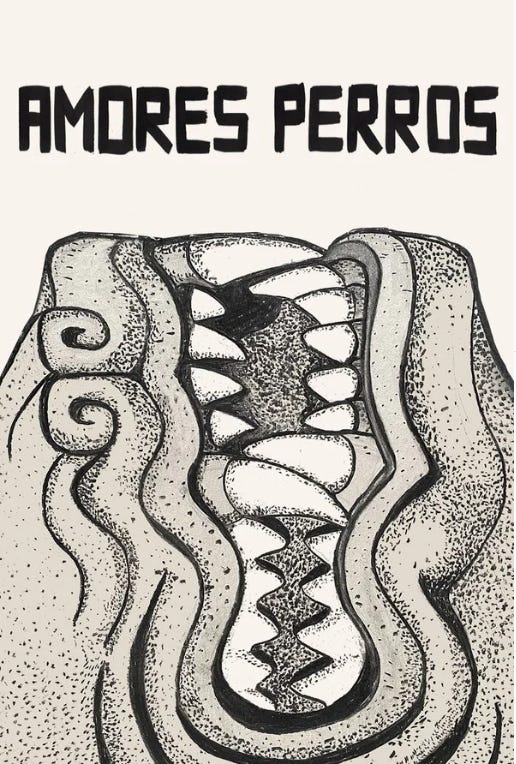
Credit: https://www.themoviedb.org/movie/55-amores-perros
It was the astonishing debut feature from director Alejandro González Iñárritu, working from a screenplay by Guillermo Arriaga. Together they produced one of the defining films of the new millennium, helping usher Mexican cinema back onto the world stage and laying the foundations for careers that would soon become international.
The structure is deceptively simple.
A horrific car crash in Mexico City becomes the point where three separate lives intersect. A teenager trying to escape poverty through dog fighting. A successful model whose perfect life collapses in an instant. A former guerrilla turned homeless assassin living among a pack of abandoned dogs.
Each story could stand alone. Together they become something far richer: A portrait of a city where class, wealth and desperation exist side by side, connected by invisible threads.
The title translates roughly as ‘Love’s a Bitch’, though that barely captures its complexity. Every character loves someone. Every act of love causes damage. Every attempt to protect another person comes at a cost.
There are no heroes here.
Gael García Bernal announced himself to the world as Octavio, a young man whose impulsive decisions pull everyone around him into catastrophe. Bernal has immense charisma, but refuses to make Octavio sympathetic simply because he’s poor. His selfishness, frustration and longing coexist naturally.
Equally extraordinary is Emilio Echevarría as El Chivo, the ageing hitman whose weathered face seems to carry the weight of Mexico itself. His scenes are among the film’s quietest, yet ultimately become its emotional centre. Living with stray dogs rather than people, El Chivo has withdrawn from humanity almost completely. His journey isn’t towards redemption exactly, but towards recognising that it may not be too late to reconnect.
Throughout the film, dogs are far more than symbolism. They reflect the people who own (or abandon) them. Loyal, brutal, neglected, exploited and resilient, they become silent witnesses to humanity’s contradictions. The dog-fighting sequences remain difficult to watch, but their purpose is never exploitation. They reveal a society in which survival itself has become transactional.
Visually, the film feels almost documentary-like. Cinematographer Rodrigo Prieto shoots Mexico City with restless handheld energy, natural light and an almost tactile roughness. The camera rarely sits still. It observes, follows and reacts, making the audience feel embedded inside lives that continue whether we’re watching or not.
Editor Luis Carballar deserves enormous credit too. The pacing is relentless without ever becoming confusing. Despite its fractured narrative, the film never loses emotional clarity. Every return to the aftermath of the crash reveals another piece of a much larger picture.
Behind the scenes, the production carried the urgency of filmmakers determined to prove themselves. Iñárritu came from radio and advertising, bringing an instinctive understanding of rhythm and image, while Arriaga’s screenplay rejected neat resolutions in favour of moral ambiguity. Their later creative split has become well documented, but Amores Perros stands as proof of how potent their collaboration once was.
The film’s influence has been enormous. Long before hyperlink cinema became fashionable through films like Crash or Babel, Amores Perros demonstrated how interconnected storytelling could deepen character rather than function as a narrative gimmick. Countless filmmakers borrowed its structure. Few matched its emotional honesty.
What makes the film endure, however, isn’t the construction. It’s the compassion.
Nobody escapes unscarred. Love destroys families, careers, marriages and lives. Yet Iñárritu refuses to suggest that the answer is loving less. Instead, he observes that human beings continue reaching for one another despite the pain that inevitably follows.
The final images carry no easy catharsis, only the quiet possibility that broken people can still choose a different path.
Raw, exhilarating and emotionally devastating, Amores Perros remains one of the greatest directorial debuts ever made. More than twenty-five years later, it has lost none of its urgency, and none of its power.