

A Prophet
Jacques Audiard, 2009

Great films you may have missed…
Jacques Audiard’s Un Prophete is a prison film that behaves like an epic without ever widening into vagueness. It’s built from tight spaces, tight hierarchies, and the tight logic of survival—yet it leaves you with the sense you’ve watched a whole society form, mutate, and export its rules beyond the walls. Audiard has described the story as a metaphor for society - “not all that different on the inside or the outside” - and the film earns that claim by the way it treats power as an everyday language you either learn or get crushed by.
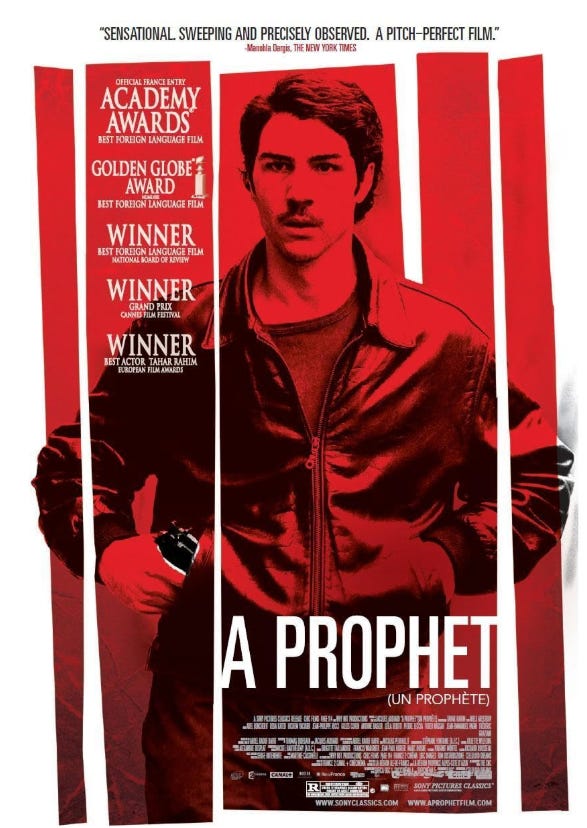
Credit: https://www.imdb.com/title/tt1235166/?ref_=mv_close
The premise is simple enough: Malik (Tahar Rahim), young and unmoored, enters prison with no obvious status or protection. What follows is not a ‘genius rises’ fantasy, but a portrait of intelligence as adaptation - watching, listening, calibrating risk, learning who controls what and how they do it. The film’s central achievement is that it makes this learning process tense without turning it into a cheer-able climb. Competence here is never clean. Every step forward is purchased with compromise, fear, and the constant awareness that the floor can drop out.
Audiard’s direction is muscular but patient. He stages scenes so that power is readable before it’s spoken: Who is standing, who is seated, who controls the pace of a conversation, who can interrupt and who has to wait. The prison becomes an organism - a system of routines, factions, trade, intimidation, petty humiliations, and sudden violence - rendered with enough granular detail that you stop thinking of it as ‘a set’ and start thinking of it as a place with its own weather.
That’s not accidental. Audiard has said they built the prison environment, and that the film effectively “emerged” from that constructed space - less a backdrop than a governing machine that shapes behaviour. The result is a world that feels architecturally inevitable: corridors that funnel you, rooms that contain you, sight-lines that expose you. The camera doesn’t need to shout; the layout does the shouting.
Audiard also refuses the flat, sociological ‘issue film’ approach. He’s on record as wanting to avoid both documentary-style explanation and imported prison clichés, instead focusing on a specific ecosystem of groups and codes. That choice is why the film stays alive: it observes rather than lectures, and it lets the viewer do the moral accounting.
One of the film’s sharpest tools is language - who speaks what, who understands what, who gets locked out of meaning. French, Arabic, and Corsican aren’t colour, so much as structure. The dialogue constantly reminds you that communication is access, and access is leverage. Even when you don’t understand a line, you understand the consequences of not understanding it.
There’s a particularly telling BTS detail here: Reviews and Cannes press coverage note that Niels Arestrup learned his lines in Corsican dialect well enough to draw praise from a Corsican reporter at the Cannes press conference. It matters because César’s authority isn’t just performance; it’s embedded in the music of how he speaks and who he speaks for. In a film where language is currency, that authenticity is an integral part of the character’s power.
Tahar Rahim’s performance is the film’s pulse. He doesn’t play Malik as an emblem or a type. He plays him as someone whose interior life is partly inaccessible even to himself - fear and calculation coexisting, ambition forming in real time, the face learning how to become a mask. Rahim talked about the difficulty of creating someone ‘totally different’, about having to invent rather than imitate, and that’s exactly what you see: A character formed by pressure - something many of us can relate to.
Arestrup, meanwhile, is a study in dominance that doesn’t need theatrics. César’s control is social, not physical - administered through intimidation, favours, humiliations, and the assumption that everyone ultimately belongs to him. Watching the film is watching a system attempt to keep itself stable while the ground shifts under it.
What keeps A Prophet from becoming a straightforward gangster-prison procedural is that it allows a second register to seep in: The psychological residue of violence - memory, dread, hallucination, superstition, whatever you want to call it. Audiard doesn’t over-explain those moments. He uses them to insist that brutality leaves traces that don’t fit neatly into cause-and-effect plotting. You might leave the film remembering not just what happened, but what it did to Malik’s inner world.
Crucially, these elements don’t romanticise the character or prettify the story. They sharpen it. They keep the film from congratulating its protagonist for ‘winning’ at the rules of a corrupt environment. If Malik becomes formidable, the film never presents that as uncomplicated triumph.
The easiest compliment to give A Prophet is that it’s ‘tense’ or ‘gripping’. It is. But the deeper compliment is that it’s structurally intelligent.. it makes you feel how power reproduces itself - how hierarchies recruit, train, punish, and eventually export their logic into the wider world. That’s the ‘society’ metaphor in action.
It also avoids the trap of being ‘important’ in a self-serious way. It’s propulsive, often brutally funny in its social manoeuvring, and relentlessly attentive to the small details that make domination believable: Who controls information, who controls movement, who controls time, who controls language.
No surprise it landed where it did at Cannes: in Competition, it won the Grand Prix in 2009. Awards of course no proof of greatness, but in this case a signal perhaps that the film wasn’t just admired, but recognised as a major piece of work in the moment. And it still feels major because it doesn’t reduce its world to a lesson. It makes you sit inside ambiguity long enough to absorb it.
If you’re interested in films about transformation, A Prophet is essential - not because it offers a comforting arc, but because it shows transformation as something earned under coercion.
A human being learns a system’s rules, becomes fluent, and then has to live with what that fluency cost. Human and quite brilliant.
Anatomy of a Flop 065
What I am suggesting is that we pull together, focussing our efforts, rather than toil in punch-drunk, demoralised isolation, to create a movement, like the Danish Dogme phenomenon of the Nineties and then utilise the mechanism already in place.
